A management services organization, or MSO, is a business entity that provides nonclinical support to a healthcare practice. Telehealth brands may use one for technology, scheduling, billing support, staffing administration, vendor management, and other operations while the medical practice and licensed clinicians retain responsibility for clinical care. Federal law does not universally require an MSO; state ownership, fee-splitting, licensure, and medical-practice rules determine whether a proposed structure works.
What is an MSO in healthcare?
An MSO is a company that provides administrative, operational, financial, technology, staffing, marketing, or related support services to a medical practice. The medical practice—sometimes called a professional corporation or “friendly PC” in private-market terminology—remains the entity responsible for professional medical services.
“MSO” describes a business arrangement, not a federal license or nationwide legal safe harbor. A structure that is permitted in one state may require changes in another. The parties need to examine what each entity actually does, who controls clinical decisions, how compensation is calculated, and how the arrangement handles patient information.
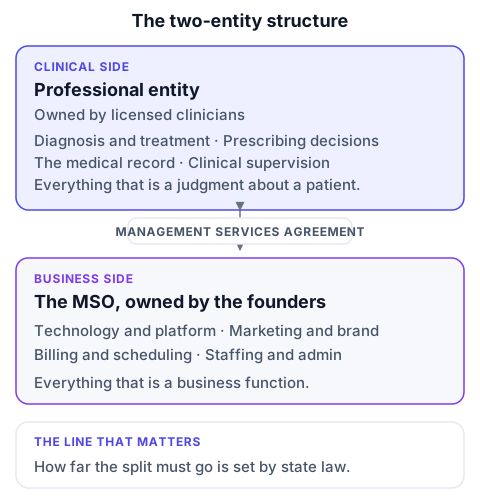
MSO vs. medical practice: what is the difference?
The MSO generally manages nonclinical infrastructure; the medical practice and licensed clinicians provide professional care and retain clinical judgment. The allocation is commonly organized as follows:
| Function | MSO | Medical practice or PC |
|---|---|---|
| Brand, software, website, and technology operations | Commonly provides or manages | May use the systems under an agreement |
| Scheduling and administrative support | Commonly provides | Sets clinical workflow requirements |
| Billing and revenue-cycle administration | May provide support | Remains responsible for compliant billing and payer obligations |
| Nonclinical staffing and vendor management | Commonly provides | May delegate administrative tasks contractually |
| Clinician contracts | Depends on applicable law and structure | Often held by the professional entity |
| Diagnosis, treatment, prescribing, and clinical judgment | Should not control | Practice and licensed clinicians |
| Medical records and protected health information | May access under appropriate agreements | Usually the covered provider controlling the clinical relationship |
| Payer enrollment and credentialing | May assist administratively | Often rests with the provider or group practice |
This is a common allocation of responsibilities, not a federally mandated model. Contracts should state the boundaries clearly rather than relying on the label “MSO.”
Why do telehealth companies use an MSO?
Telehealth brands commonly consider an MSO for five practical reasons:
- 1To separate commercial operations from clinical services. The brand, technology, customer support, and administrative functions can be organized separately from the professional practice.
- 2To centralize infrastructure. One operational entity may coordinate scheduling, billing support, analytics, vendor relationships, and platform services.
- 3To create a repeatable operating model. A centralized platform may support expansion, although each target state still requires its own review.
- 4To document clinical independence. A services agreement can identify that clinical judgment belongs to the practice and licensed clinicians, not the commercial company.
- 5To clarify responsibilities. The parties can address staffing, technology access, data handling, intellectual property, insurance, fees, and termination.
These are organizational rationales, not conclusions that a particular MSO arrangement complies with state law. Founders evaluating a specialty launch can also review how a specialty practice launches telehealth services and why specialty practices are adding direct-to-consumer telehealth.
Does every telehealth business need an MSO?
No. An MSO is not universally required by federal law. Some businesses use one because it separates the commercial and operational business from the medical practice; others may use a different structure.
The answer depends on the target states, ownership model, services, clinician relationships, payer participation, and data flows. State-specific review may be needed for:
- Corporate-practice-of-medicine restrictions
- Ownership or control of a professional entity
- Whether a nonphysician company may employ or contract with clinicians
- Limits on MSO influence over clinical decisions
- Fee-splitting and management-fee rules
- Referral compensation and marketing-payment restrictions
- Professional-entity formation and licensing
- Telehealth practice-location and clinician-licensure requirements
- Patient-record custody and access
- Payer enrollment and commercial payer contracting
The approved federal sources for this article do not establish state-specific friendly-PC, ownership, or fee-splitting rules. Those issues require review of the relevant state statutes, board guidance, agencies, and qualified counsel.
What is a friendly PC model?
In a friendly-PC model, a professional medical entity is owned or controlled as required by applicable professional-entity law, while a separate MSO provides nonclinical services under a written agreement. The intended division is to keep clinical decisions with the medical practice while allowing the commercial company to operate technology and administrative infrastructure.
The phrase does not mean that every telehealth company needs a physician-owned PC, that an owner is merely a nominee, or that the MSO can control the practice without restriction. State law may determine who can own the professional entity, what the MSO may control, and how the parties may be paid.
A management agreement also does not automatically solve corporate-practice, fee-splitting, licensure, or payer-compliance questions. The arrangement must be evaluated by function and by jurisdiction.
Can an MSO access patient information?
Yes, an MSO may access protected health information (PHI) in performing covered administrative or management services, but the relationship may make the MSO a HIPAA business associate. HHS identifies management, administrative, billing, claims-processing, data-analysis, and financial services as activities that can create a business-associate relationship when performed for a covered healthcare provider and involving PHI.
If the MSO is a business associate, the medical practice generally needs a written business associate agreement (BAA). The BAA should address permitted uses and disclosures, safeguards, breach reporting, subcontractors, and the return or destruction of PHI when appropriate. Business associates can also be directly liable for certain HIPAA obligations.
The practical test is not whether the company calls itself an MSO. Map whether it can access records, scheduling information, billing data, messaging systems, or other PHI, then document the applicable responsibilities and downstream relationships.
How does Medicare billing affect an MSO structure?
Medicare billing and enrollment require separate review. CMS materials distinguish between individual physicians or nonphysician practitioners and clinic or group practices for enrollment and reassignment purposes, including processes associated with CMS-855R.
An MSO services agreement does not by itself resolve enrollment, reassignment, authorized-official, credentialing, ownership, or payer-contract requirements. If the business will bill Medicare or another government program, identify which entity enrolls, contracts, submits claims, and receives or reassigns billing rights before launch.
How should a founder evaluate an MSO structure?
Use this sequence before signing a management-services agreement:
- 1List the target jurisdictions. Do not assume one structure can be copied nationwide.
- 2Identify the clinical entity. Determine which entity provides professional services and contracts with clinicians.
- 3Map the functions. Separate technology, scheduling, customer support, staffing administration, billing support, marketing, and vendor management from diagnosis, treatment, prescribing, supervision, and clinical protocols.
- 4Map data access. Identify who can view PHI and whether BAAs or subcontractor agreements are needed.
- 5Review compensation. Determine whether fees are fixed, cost-plus, fair-market-value based, or tied to collections, then obtain state-specific review for fee-splitting concerns.
- 6Confirm payer responsibilities. Identify the entity responsible for enrollment, credentialing, contracts, billing, and claims.
- 7Test the exit plan. Address records, patient access, clinician relationships, platform access, brand assets, and data when the agreement ends.
- 8Obtain qualified review. Have healthcare regulatory counsel and relevant state authorities or boards inform the jurisdiction-specific analysis.
Founder checklist
Before adopting an MSO structure, answer these questions in writing:
- Which entity contracts with clinicians?
- Which entity is the healthcare provider or covered entity?
- Which entity owns or controls medical records?
- Will the MSO access PHI, and is a BAA required?
- Which entity contracts with payers and submits claims?
- Who controls clinical protocols, diagnosis, treatment, and clinician supervision?
- What services does the MSO provide, and what authority does it not have?
- How are management fees calculated?
- Who owns the brand, software, domain, and patient-facing technology?
- What changes when the business expands into another state?
- What happens to records, patients, clinicians, and platform access at termination?
How can a telehealth platform fit into an MSO model?
MDLaunchr is the brand behind WhiteLabelClinic.com, a white-label telehealth infrastructure platform designed to help qualified businesses evaluate and coordinate technology, operational, compliance, clinical-network, and fulfillment relationships. It is one platform in this category—not a law firm, regulator, treating practice, or substitute for state-specific review.
The useful question is not whether a platform supplies a universal MSO template. It is whether the proposed technology and operating relationships match the actual clinical entity, data flows, payer model, and jurisdictions involved. Businesses can review a realistic telehealth launch timeline while identifying those dependencies.
Explore how MDLaunchr and WhiteLabelClinic.com can support a compliance-first telehealth launch, with legal, clinical, and regulatory review handled by appropriately qualified professionals.
The bottom line
An MSO is a nonclinical business entity that supports a medical practice. Telehealth brands may use one to organize technology, administration, staffing support, billing operations, and vendor relationships while the medical practice and licensed clinicians retain responsibility for professional care. Whether the structure is appropriate depends on state law, the parties’ actual functions, compensation, data access, payer model, and clinical governance—not on the MSO label alone.
Related reading: the full guide this article belongs to.
Written and reviewed by MDLaunchr's clinical and compliance team. We build white-label telehealth infrastructure for founders, creators, and healthcare operators—covering providers, pharmacy, technology, and compliance.
This article is for general informational and educational purposes only and is not medical, legal, or regulatory advice. It does not create a provider-patient relationship and should not be used to diagnose or treat any condition. Telehealth and compounding regulations vary by state and change over time—consult qualified legal, clinical, and compliance professionals before launching or operating a telehealth program.
Frequently asked questions
What does MSO stand for in medical practice?
MSO stands for management services organization, a business entity that provides nonclinical administrative, operational, financial, technology, staffing, or related support to a medical practice.
Is an MSO the same as a medical practice?
No. An MSO generally manages business and administrative functions, while the medical practice and licensed clinicians provide professional care and retain clinical responsibility.
Why do telehealth companies use an MSO?
Telehealth companies may use an MSO to separate commercial operations from clinical services, centralize technology and administration, document responsibilities, and support a repeatable operating model.
Can an MSO employ doctors?
The answer depends on applicable state law and the structure, so a founder should review professional-entity ownership, corporate-practice, licensure, and clinical-control rules before proceeding.
What is a HIPAA business associate agreement for an MSO?
A BAA is a written agreement generally used when an MSO performs covered functions for a healthcare provider and handles PHI; it addresses permitted uses, safeguards, breach reporting, subcontractors, and PHI disposition.
How does an MSO get paid by a medical practice?
An MSO may be paid under a written services agreement, but the permissible fee method is state-specific and should be reviewed for fee-splitting and other regulatory concerns.
- U.S. Department of Health & Human Services — Covered EntitiesBusiness AssociatesSample Business Associate Agreement ProvisionsFactsheet
- Centers for Medicare & Medicaid Services — National Provider Enrollment Conference Faqs April 2018